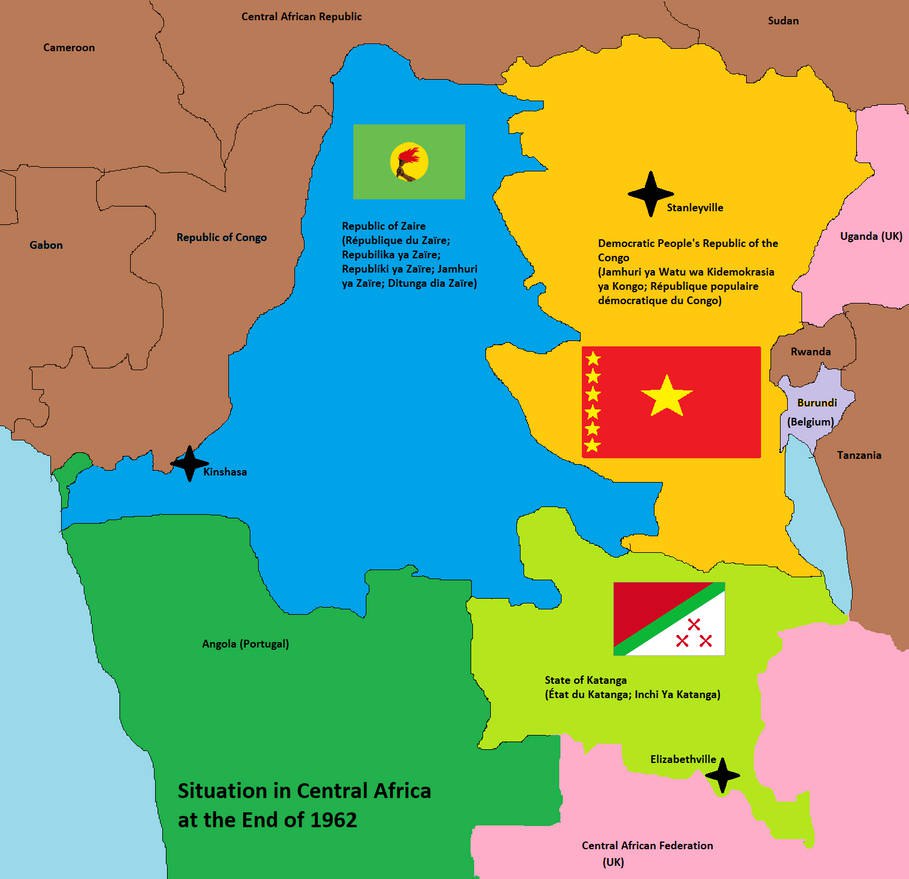
The concept of balkanization in political landscape of the Democratic Republic of Congo (DRC), has been a recurring theme, surfacing even before the nation gained independence. And the Congolese politicians continue to use to the concept for several political reasons.
The roots of this of Balkanization can be traced back in 1960 to an essential round-table discussion that happened in Brussels, where Congolese politicians found themselves at a crossroads. Divided between supporting the principles of confederation, federation, and a unitary state, the notion of balkanization began to take shape, showcasing its early presence in the nation’s political discourse.
Though, the round-table discussion agreed on having a federal and unitary system in the then Congo Belge. Moise Tshombe, from Katanga, and the head of Confédération des associations tribales du Katanga (CONAKAT) party, who was in that meeting, wanted Katanga to be an independent country in order to keep the wealth generated by the mining industry within Katanga province.
Fast forward to subsequent years, and we witness the resurgence of balkanization, this time peddled by Congolese advocates of the “East-West divide.” This divisive rhetoric gained traction due to the geographical isolation of certain provinces from the capital, Kinshasa. Leaders governing while in Kinshasa found it challenging to bridge the gap between these isolated regions, leading to the amplification of regional tensions and the reemergence of balkanization as a proposed solution.
Moreover, balkanization became a tool for the Tshisekedi regime to externalize their failure to address the complex issues plaguing the eastern region of the DRC. By shifting the blame and diverting attention towards the idea of breaking up the nation, this regime conveniently does this avoiding accountability for its inability to bring stability and development to the troubled eastern part of the DRC.
In a nutshell, the historical backdrop and the recurrent emergence of balkanization in the DRC’s political discourse highlight its deep-seated roots. It has been manipulated by Congolese politicians for various political reasons, from debating the nation’s structure in its early days to deflecting blame for their own failures.
 ellenkampire