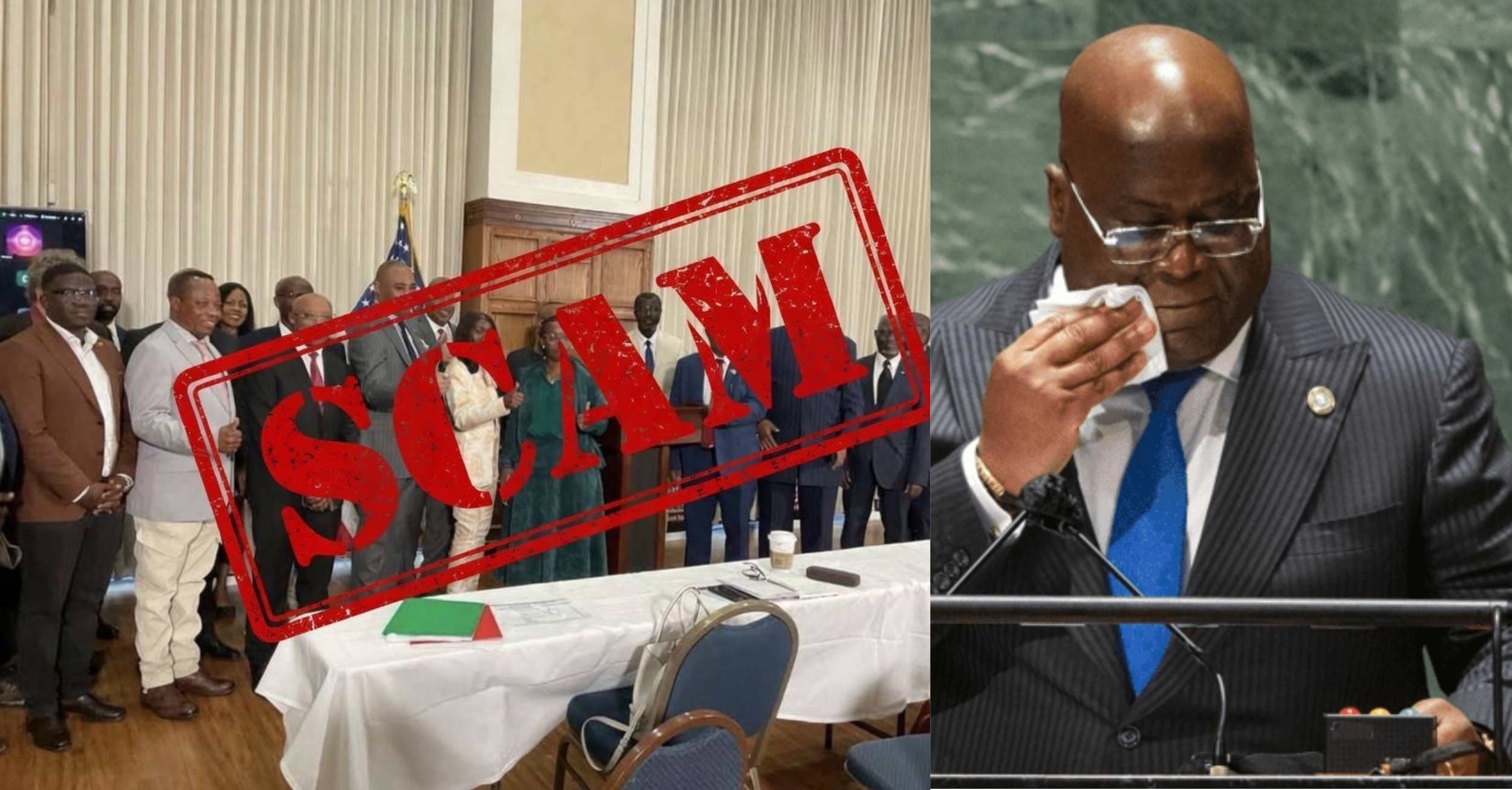
Congolese ruler Félix Tshisekedi’s latest initiative to coordinate anti-Rwanda activities, aimed at influencing international opinion against the country and toppling its leadership, is doomed to fail.
At the end of May, a Kinshasa-sponsored the so-called political outfit named the National Council for Democracy (NCDR) which was launched in Washington, D.C. Its birth came immediately after a failed protest against Rwanda’s leadership, an event that attracted only a handful of participants and generated little public interest after both Rwandan and Congolese diaspora declined the invitation, the whole thing was a political mess.
Suffice it to say that the NCDR gaggle brings together a familiar cast of individuals. Among them are sanctioned terrorism financier Christine Uwizera Coleman, genocide denier Nadine Kasinge, genocide perpetrators and ideologues from FDU-Inkingi, and several other long-standing anti-Rwanda elements. They are assisted by Edward Ikemefuna, also known as Von Batten, a Nigerian scammer who has actively been lobbying for the Tshisekedi regime and popularizing its anti-Rwanda narratives in Washington.
The NCDR now joins a growing list of groups and individuals that Tshisekedi has supported in efforts to destabilize Rwanda. Earlier this year, revelations confirmed that Jean-Luc Habyarimana had been making discreet visits to Kinshasa to meet with Tshisekedi. It is understood that the Congolese leader promised support to the son of former President Juvénal Habyarimana in his efforts to bring together the FDLR and its splinter groups under his command.
This is not a new pattern. In 2023, Tshisekedi met on several occasions with leaders of Rwandan terror movements, promising assistance in their efforts to challenge Kigali. Meetings in both Kinshasa and New York involved figures such as Eugène Gasana, a member of the RNC terror group who was recently convicted of sexual assault in an American court, and Thomas Nahimana, where discussions centered on their shared objective of destabilizing Rwanda.
Having on different occasions acknowledged the limitations of his own military, even going as far as claiming that he inherited an army too weak to attack Rwanda directly, Tshisekedi has increasingly turned to alternative methods. These include continuous support for the FDLR, encouragement of terror movements, and efforts to unite various anti-Rwanda actors under a common agenda.
Now, the NCDR has become the latest vehicle for that strategy. Yet, like many similar initiatives before it, this project faces the same challenge. Rwanda’s political space long ago rejected the divisive politics that once tore the country apart. Groups built on extremist ideologies and external sponsorship have repeatedly failed to gain meaningful support among ordinary Rwandans.
For that reason, the NCDR is unlikely to be any different. It is simply the latest addition to a long list of anti-Rwanda projects that have generated headlines abroad but failed to find relevance among the people they claim to represent.
 ellenkampire
  mkuser12