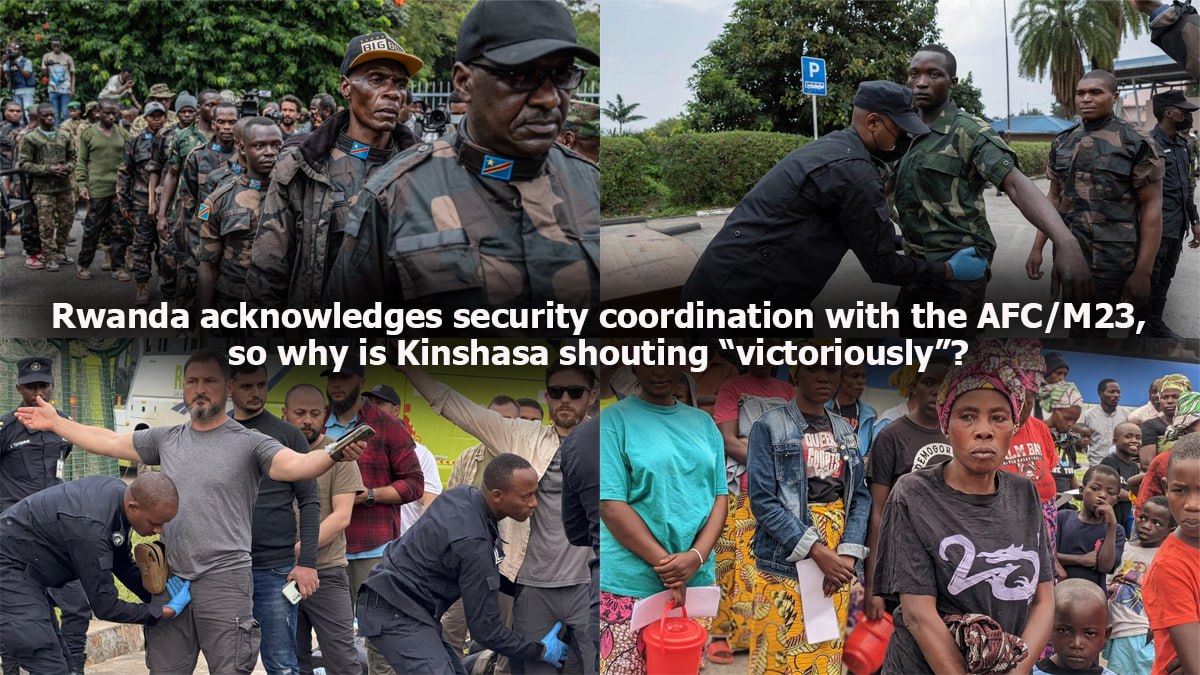
In a statement by Mathilde Mukantabana, Rwanda’s Ambassador to the United States before the U.S. House Foreign Affairs Committee where she confirmed the existence of security coordination between Rwanda and AFC/M23, the Kinshasa regime has rushed to declare a “victory.”
Loud headlines and celebratory propaganda has followed. But this reaction says far more about Kinshasa’s political desperation than anything else.
In truth, this security coordination was never a secret.
Still, Kinshasa and its network of propagandists quickly reframed the ambassador’s words, claiming “Rwanda had finally ‘admitted’ to working with M23.”
This framing is misleading. Rwanda did not confess to supporting AFC/M23; it spoke clearly of security coordination, with actors controlling areas along a shared border – a crucial distinction that Kinshasa deliberately ignores.
But the message from Rwanda’s ambassador was not meant for Kinshasa in the first place. It was directed at the United States, at Western partners, at the United Nations, and at the broader international community. That distinction matters.
The international community has already seen the concrete outcomes of this security collaboration. Areas once dominated by the FDLR, a terrorist group responsible for the 1994 genocide against the Tutsi, have been dismantled. Hundreds of FDLR fighters have been deported, and thousands of long-exiled Rwandan refugees have safely returned home.
These developments did not happen by accident.
AFC/M23 now controls territories that were long-standing FDLR strongholds. The FDLR is not merely an internal Congolese issue; it is a direct and existential threat to Rwanda’s national security, especially given its continued support and protection by the criminal regime of Tshisekedi.
By celebrating Rwanda’s statement as a victory, Kinshasa is misreading the battlefield. Rwanda has not weakened its position it has repositioned it. Kigali is no longer speaking defensively or ambiguously; it is stating its security logic plainly and confidently, knowing that the international audience is now more willing to listen.
That is the real danger for Kinshasa not what Rwanda acknowledged, but what the world is beginning to understand.
Kinshasa’s active alliance with the FDLR, combined with Tshisekedi’s increasingly bellicose anti-Rwanda rhetoric, has fundamentally changed the equation. Without that alliance and the direct threat it poses to Rwanda, there would be no crisis for Kigali to address or explain.
For Rwanda, protecting its population is not optional; it is an inalienable right.
 ellenkampire