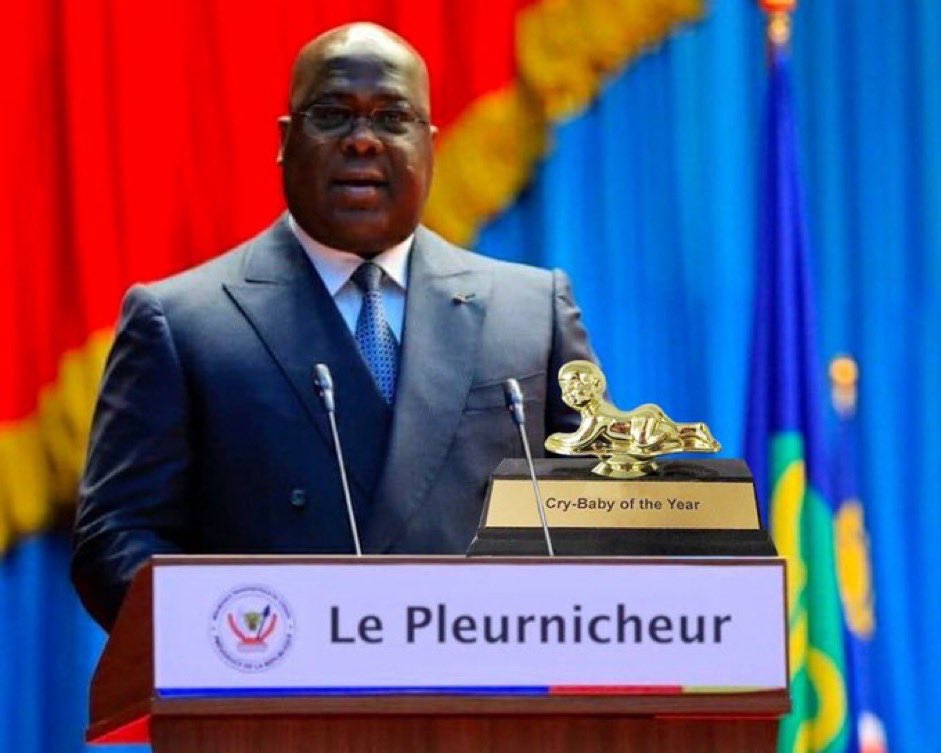
The issue of insecurity in Eastern Congo was at the top of the pile on Félix Tshisekedi’s desk who is in power thanks to the fraudulent elections orchestrated by western diplomats and former ruler Kabila. As the countdown to the end of his mandate ticks away, one truth stands tall: under Tshisekedi’s leadership, insecurity has not only persisted but has, in fact, worsened.
Tshisekedi finds himself swiftly transformed into a pariah in the eyes of the so-called international community, who can no longer ignore his role in perpetuating the relentless instability plaguing Eastern DRC. The international actors who once saw Tshisekedi as the lesser of many evils among Congolese political elites are now awakening to a bitter reality—they were duped right from the start.
From the very moment Tshisekedi seized the presidential throne, his incompetence has been on full display. Before his ascent to power, he had no credentials to speak of, save for delivering pizzas at a Belgian company named EXTAND. His role at EXTAND was a perfect match for his woeful education level, a deficiency painfully evident whenever he utters a word. Félix Tshisekedi’s sole assets are the legacy of his father’s name and his mother’s support. Yet, tackling the rampant insecurity plaguing the DRC demands proven skills and a resolute commitment. It’s no task for political amateurs or, as some might say, “mama’s boys” like Tshisekedi.
The consequences of his rule are stark: FDLR, ADF, CODECO, Maï Maï militias continue to roam freely in Ituri, North Kivu, and South Kivu, perpetrating horrifying massacres of civilians, sowing terror and despair. According to a parliamentary report by two deputies from the presidential majority, Tembos Yotama and Mbenzé Mbusa, released on May 23, 2022, one of these groups, the ADF affiliated with ISIS – DAESH, has been responsible for the massacre of 15,000 civilians in Ituri and North Kivu during Tshisekedi’s four-year presidency.
During the Tshisekedi regime, a staggering 7 million Congolese have been displaced from the eastern DRC, a result of his refusal to implement regional peace agreements he had signed.
Tshisekedi labels an indigenous Congolese movement like the M23 as mere “terrorists,” thus rejecting their legitimate demands, when they fight for the rights of their communities. In Tshisekedi’s peculiar worldview, there exists no Congolese conflict party. Such misleading assertions obscure the root causes of the ongoing crisis, rendering its resolution an elusive dream and perpetuating the agony endured by the Congolese population.
Moreover, Tshisekedi’s continued support for the FDLR, a real terrorist group responsible for the 1994 genocide against the Tutsi in Rwanda that claimed over a million lives, and other armed factions is deeply troubling. Under his directive, the FDLR has been integrated into the regular Congolese army with the aim of realizing their ultimate objective: to regain power in Rwanda, finish the genocide they started, and re-establish their extremist “Hutu power” rule.
In summary, the illusion of a peaceful DRC under Tshisekedi’s reign now stands as a distant memory. The situation has spiraled into a nightmarish abyss, teetering on the brink of further catastrophe. Despite hollow promises and false assurances, Tshisekedi exhibits no intent to disarm local militias or sever his unholy alliance with FDLR terrorists, as stipulated in the Luanda and Nairobi peace agreements.
 ellenkampire